Rug Size by Room: What Changes When You Measure Twice
Back width, the 18-inch overhang rule, and why a 9×12 that fits the dining table often looks wrong in the room. The numbers that decide rug size.
The Calm Finds editorial desk · Published Sep 24, 2026 · Updated Oct 2, 2026 · 8 min
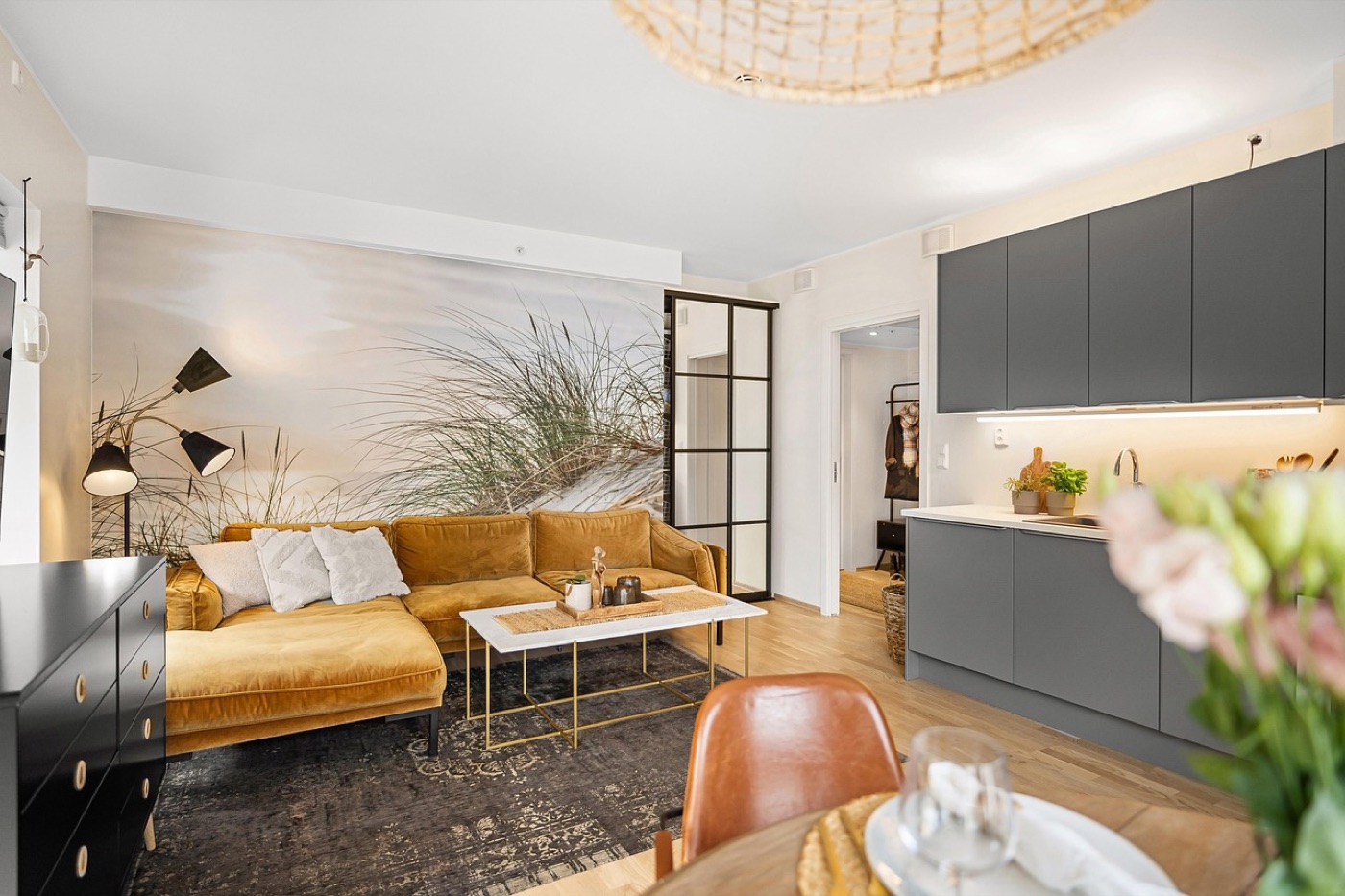
Size is the only rug decision you cannot undo
Every other property of a rug — colour, pile, material — can be lived with. Size is fixed the moment it arrives. A rug that is too small cannot be extended, and the mistake shows as an empty band of floor running around all four sides, which is the single most common reason a rug reads as an afterthought rather than a choice.
Three measurements decide it: the room, the furniture that sits on it, and the roll the rug was woven on. The third is the one nobody mentions.
The dining table rule, and where it stops working
The familiar guidance is that a dining rug should extend 18 inches beyond the table on every side. The reasoning is mechanical rather than decorative: a chair pulled out needs its legs to remain on the rug, and a six-seat table with 18 inches of overhang achieves that.
| Table seats | Table size | Minimum rug | Notes |
|---|---|---|---|
| 4 | 36–42 in round | 5 ft round or 6×8 | Overhang mostly decorative here |
| 6 | 60×36 rectangular | 8×10 | 18 in on all four sides |
| 6 | 72×36 rectangular | 9×12 | Comfortable, works in most rooms |
| 8 | 84×36 rectangular | 9×12 minimum | Consider a 10×14 in a large room |
The rule breaks down in two situations. In a room where the table sits close to the walls, a rug that reaches the walls on the long sides and stops short on the ends looks better than the reverse. And in a very small dining nook, an undersized rug hung entirely under the table reads better than a correctly sized one that leaves only a token margin — the eye reads that margin as an error.
Back width, the measurement that arrives too late
A rug is woven on a roll, then cut. The width of that roll is the back width, and if the finished rug is narrower than its roll, the pattern repeats when the rug is laid out — sometimes visibly, sometimes only if you know where to look.
Back widths are typically 6 ft 2 in, 8 ft, 9 ft 6 in, 11 ft 4 in, or 13 ft 9 in. The common failure case: a 9×12 rug has an area of 108 square feet. Laid out using 11 ft 4 in of width needs about 9 ft 6 in of length, which fits. But a rug sold as 9×12 that was cut from an 8 ft roll has to piece its length from two widths — and a flatweave with a visible direction shows that seam as a line. Before buying, check the stated back width; if it is not stated, that is a question worth asking rather than an assumption worth making. The full list of terms involved is in the rug vocabulary.
The three sizes, and which room each one is for
If the room takes a 9×12, that is the size to aim for when the table seats six and stands away from the walls. The specification that decides whether a given 9×12 works is the back width: it must be 11 ft 4 in or wider, or the panel is pieced and a flatweave will show the seam as a line across the field. Most listings do not state it, so treat an unstated back width as a question rather than an assumption.
If the room takes an 8×10, that is the common choice for a six-seat table in a mid-sized dining room, and the size least likely to hit the piecing problem — rolls for 8×10 are usually 8 ft wide, matching the finished width. Most tufted rugs at this size carry a latex backing, which limits how they can be rolled through a narrow doorway.
If the room is small, a 5×8 is correct rather than small. In a room under about 10 by 10 feet it leaves a visible margin on all four sides, which reads as deliberate. The same rug in a 16-foot room reads as undersized and the floor dominates.
When a smaller rug is the right answer
Not every room wants a large rug.
- A room with two distinct zones. Separate seating and a reading corner often read better with two rugs than one rug trying to cover both.
- A room under 10 by 10 feet. A rug that leaves 12 inches of floor on all sides reads as intentional. The same rug in a 16-foot room reads as undersized.
- Hardwood floors worth seeing. In an older house with good boards, a small rug floating centrally preserves the floor as a feature.
Take the measurements first — the five-measurement list is the longer version of this. Then buy the rug. Doing it in the other order means choosing the rug first and negotiating with the room afterwards, which is the version of this where people come to regret the purchase.
The picks
Some links below are affiliate links — we may earn a commission at no extra cost to you. As an Amazon Associate, we earn from qualifying purchases.
For a dining room where the table seats six and stands away from the walls, a rug needs to reach roughly 18 inches beyond the table on every side so that pulled-out chairs stay on it. That means an 8×10 at minimum and a 9×12 where the room allows. What matters more than the stated size is the back width: a rug cut from a roll narrower than its finished width has to piece its length, and in a flatweave that seam reads as a line across the field.
- Minimum for a 6-seat table
- 8×10 ft
- Comfortable for 6 seats
- 9×12 ft
- Overhang needed
- 18 in all sides
- Check before ordering
- Back width vs roll
- Do not forget
- Door swing clearance
If the room takes a 9×12
What to verify before ordering
A 9×12 is the size to aim for when the table seats six and stands away from the walls. The specification that decides whether a given 9×12 works is the back width: it must be 11 ft 4 in or wider, or the panel is pieced and a flatweave will show the seam as a line across the field. Most listings do not state it — treat an unstated back width as a question, not an assumption.
- Finished size
- 9 ft × 12 ft
- Back width to verify
- 11 ft 4 in or wider
- Construction
- Flatweave shows seams; tufted hides them
- Room to suit
- About 200 sq ft and up
If the room takes an 8×10
The size most 6-seat tables actually fit
The common choice for a six-seat table in a mid-sized dining room, and the size least likely to hit the piecing problem — rolls for 8×10 are usually 8 ft wide, matching the finished width. Most tufted rugs at this size carry a latex backing, which limits how they can be rolled for transport through a narrow doorway.
- Finished size
- 8 ft × 10 ft
- Back width to verify
- 8 ft or wider
- Overhang achieved
- About 18 in on each side
- Construction
- Tufted, latex-backed
If the room is small
When 5×8 is correct rather than small
In a room under about 10 by 10 feet, a 5×8 leaves a visible margin on all four sides, which reads as deliberate. The same rug in a 16-foot room reads as undersized and the floor dominates. Rolling it is easy, which matters if the rug ever has to move.
- Finished size
- 5 ft × 8 ft
- Best for
- Rooms under 10×10 ft
- Treatment
- Centre, leave floor visible
- Check first
- Furniture footprint vs rug size
| Specification | 5×8 | 8×10 | 9×12 |
|---|---|---|---|
| Dining table | 4-seat only | 6-seat | 6–8 seat |
| Overhang achieved | Partial | About 18 in | About 18 in all sides |
| Roll width usually | 6 ft 2 in | 8 ft | 11 ft 4 in |
| Pieces its length | No | No | Only if roll is under 11 ft 4 in |
| Reads as intentional below | 90 sq ft room | 150 sq ft room | 200 sq ft room |
| Sofa treatment | Front legs only | Front legs only | All legs on if it fits |
Where these numbers come from
Frequently asked
- What size rug should I buy for a 12×12 room?
- A 9×12 leaves roughly 18 inches of bare floor on two sides when placed under a dining table, which is the point — the chairs need to stay on the rug when pulled out. A 12×12 rug in a 12×12 room covers everything and removes the visual anchor entirely, which is why it usually reads as "too much rug."
- What is the 18-inch overhang rule?
- The dining table chairs should stay on the rug when pulled out. For a table that seats six, that works out to about 18 inches of rug on each long side and 18 inches on each end. Below that, chairs sit off the rug entirely and the dining set visually detaches from the room.
- Should the rug run under the front legs of my sofa?
- Only the front legs. A rug that slides fully under a sofa reads as though it was installed rather than chosen. Front legs on, back legs off, is the standard treatment because it makes the furniture look deliberate.