Curtain Rods and Tracks: Span, Weight and Mounting
The hardware decides whether a curtain works: how far a rod should span, what a bracket actually carries, when a centre support is needed, and where tracks win.
The Calm Finds editorial desk · Published Oct 10, 2026 · 6 min
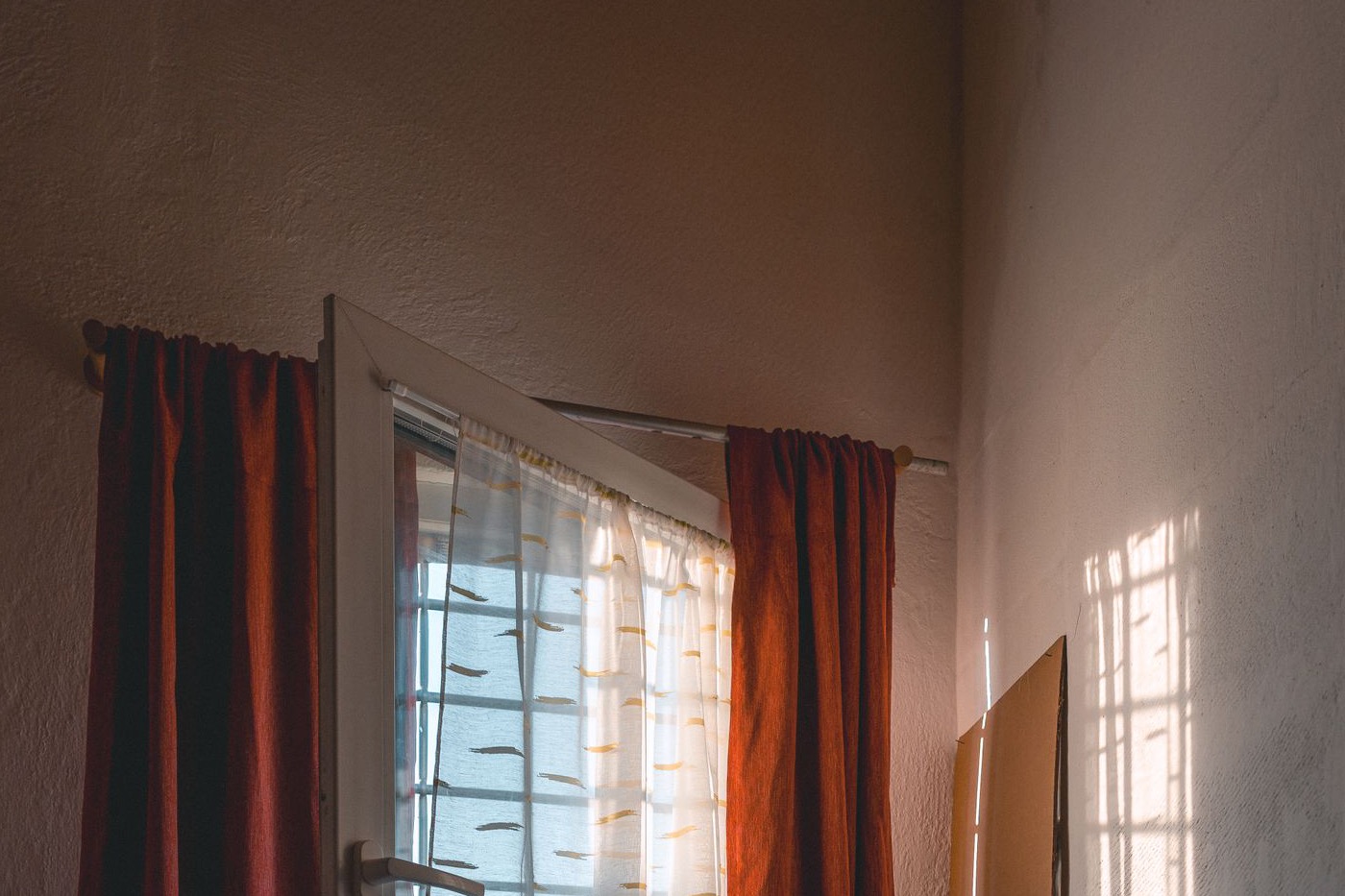
Curtain hardware is usually chosen last and chosen decoratively, which is backwards, because the rod or track is the load-bearing part of the window treatment. Every property a curtain has — how far it opens, how it hangs, whether it draught-proofs the window — is granted or cancelled by the hardware it runs on. The fabric decisions come first in the ordering for good reason, but the hardware decides whether they survive contact with the wall.
Span: the rod exists for the open curtain
The most common hardware mistake is sizing the rod to the window. A rod barely wider than the frame leaves the open curtains nowhere to go: they stack across the glass, and the window loses its edges of light every day of its life.
The working rule is fifteen to twenty centimetres beyond the frame on each side, so a pair of panels can clear the glass completely when open. On a wide window the calculation changes slightly — beyond about three metres of span, the stacking width of the fabric itself becomes the constraint, and the rod extends as far as the stacked curtain needs rather than a fixed number. The fullness arithmetic that determines how wide the fabric must be is in the width and fullness guide, and the stacked width is roughly a quarter to a third of it.
Height is the other half of mounting. The higher the rod, the longer the drop, and the drop has its own logic covered in the drop versus ceiling height guide. What matters at the hardware stage is only that the bracket position is decided before the curtains are ordered, because a rod moved upward after the fact leaves a bare strip of wall and a hem floating above the floor.
Weight: what a bracket actually carries
A lined curtain is heavier than it looks. Fabric weight is rated in grams per square metre — the arithmetic is in the fabric weight guide — and the load on the brackets is the fabric weight times the area, times the fullness, plus the hardware itself. A three-metre pair of lined, interlined curtains at 280 grams per square metre with two-times fullness puts ten-odd kilograms on two small brackets screwed into plaster. That is the number the mounting has to hold, repeatedly, with daily tugging added.
Three consequences follow.
The fixing matters more than the bracket. A bracket into stud or masonry holds whatever the rod weighs. A bracket into plasterboard alone holds a fraction of that, and the failure is not sudden — the bracket leans out a millimetre at a time until the rod sits at an angle. Wall anchors rated for the real load, or a fixing into the lintel or stud above the frame, are the difference.
Pole diameter is a stiffness question. A thin pole over a long span flexes and binds; rings that slide freely on a straight pole catch on a bowed one. Twenty-five millimetres is fine for a window’s worth of light fabric; thirty-five and up for long spans or heavy curtains, or a pole sold with a centre support.
The centre support is the forgotten part. Beyond roughly two metres, a rod needs a third bracket, and a plain bracket in the middle of the travel path stops the curtain dead as the rings hit it. Either the bracket is offset above the pole’s line so rings pass beneath, or it is a passing bracket designed for the rings to run over. This single detail is behind most “the curtain won’t close properly” complaints on wide windows.
Where tracks beat poles
A track is less photogenic and more capable. Four situations argue for one.
Bay and awkward windows. A track bends to the bay’s geometry in a way no pole can, and the curtain travels around the angles instead of hanging dead at the first one.
Ceiling mounting. Where the wall beside the window is too shallow for a bracket, or the window reaches nearly to the ceiling, a ceiling track removes the wall from the problem entirely. It also puts the whole wall height into the drop, which is the mechanism behind floor-to-ceiling curtain walls.
Heavy, lined curtains. A track spreads load across many small fixing points instead of two or three brackets, and glides carry weight with less friction than rings on a pole. Heavy interlined curtains that drag on a pole usually run freely on a track.
Layering. A double or triple track stacks a sheer behind a main curtain on the same mounting, with each layer moving independently. The layering logic is in the lining and layers guide; the hardware point is that layering on poles needs two rods and two sets of brackets, which doubles the load on the same wall fixings.
The honest limit of tracks is appearance and light. A track is visible unless it is recessed, and a ceiling-mounted track leaves a slot of light between curtain top and ceiling unless the curtain hangs above the track’s own line — the same top gap that undermines blackout performance if it is left unaccounted for.
A short fitting checklist
The whole decision compresses to five checks, and all of them happen before the fabric is cut. Mark the bracket or track positions on the wall and look at them — mounting errors are free to fix in pencil and expensive in plaster. Confirm what is behind the surface at each fixing point. Add up the real weight of the intended fabric at its real fullness. Count the brackets against the span, including the centre. And run something heavy along the empty rod or track before the curtains go up, because binding discovered at that stage is a hardware problem, and discovered a week later it is a curtain problem.
Frequently asked
- How far should a curtain rod extend past the window?
- Fifteen to twenty centimetres each side is the working range for a pair of panels that stack off the glass. The rod exists so the open curtain has somewhere to live: panels stacked on the frame itself block light at the edges, which is the gap that no lining can fix. Very wide windows can justify more, but the useful test is where the stacked fabric actually sits, not the number.
- Do I need a middle bracket on my curtain rod?
- Almost always beyond about two metres of span, and always if the manufacturer specifies one. A rod sags invisibly at first — curtains begin to drag toward the centre, rings catch, and the finish on an aluminium pole wears along the sag line. The centre bracket must be offset so the rings can pass it, or it must be a passing type; a plain bracket in the travel path stops the curtain dead.
- Are ceiling-mounted tracks better than wall rods?
- For specific jobs, yes. A ceiling track puts the full wall height in play, works where there is no solid wall to drill into beside the window, handles bays with made-up bent sections, and carries heavy lined curtains without a long lever arm on plaster. A pole wins on appearance and on fitting freedom. The fabrics behave the same on both; the mounting is what differs.