Sheer Curtains: Privacy by Day, Fishbowl by Night
Sheers soften light and cut glare, but their privacy runs one direction only. Openness factors, voile versus linen, and why sheers need a partner after dark.
The Calm Finds editorial desk · Published Oct 8, 2026 · Updated Oct 12, 2026 · 5 min
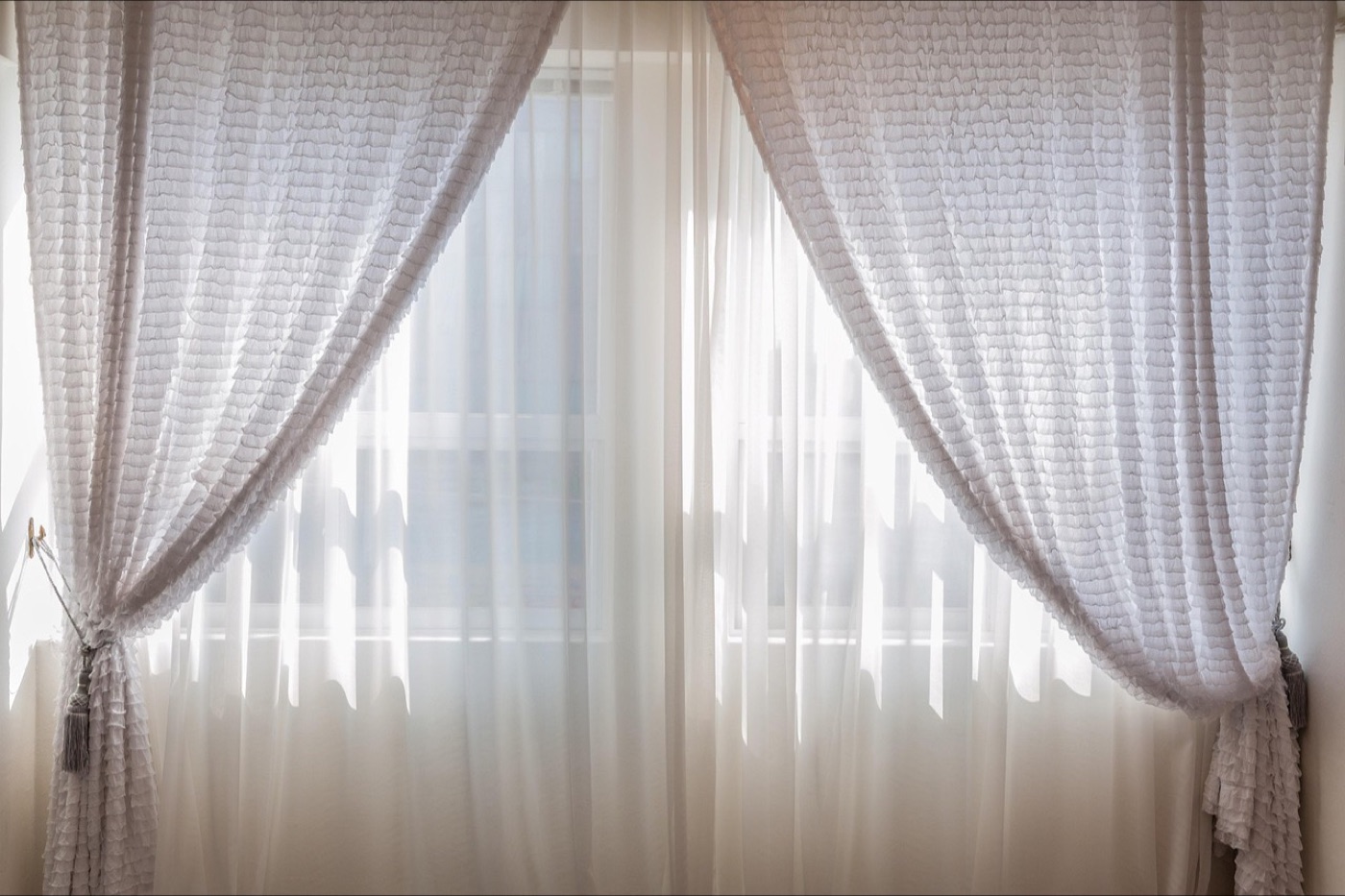
Sheers are the curtain most often bought for one property and judged by another. People buy them for the soft light, then discover at 9 pm, lamp on, that they have installed a screen for the neighbourhood. Neither half of that experience is a defect; it is how light works through translucent fabric. The fix is understanding which direction the privacy points.
What a sheer actually does to light
A sheer diffuses: it breaks direct sun into scattered light, kills glare on screens, and takes the hard edge off a west-facing room. Measured, a polyester voile transmits most of the light that hits it, somewhere in the 60 to 75 percent band, while changing its character completely.
The contrast with the other categories is worth stating in the same units. Light-filtering curtains, the unlined medium-weight fabrics, transmit roughly a third to half. Blackout, which is a construction rather than a colour, transmits under 1 percent, and the claims game around that word is covered in blackout curtains and light blocking. A sheer sits at the airy end of that scale, deliberately.
Fabric choice moves the numbers less than people expect. Polyester voile, the standard, is durable, washable and cheap. Linen sheers hang with more texture and slub, cost more, and wrinkle where voile does not. Cotton voile sits between. What all three share is the transmission behaviour; what differs is drape, which fabric weight and drape unpacks.
Privacy: the one-direction problem
Daytime privacy depends on light balance, not fabric. When the outside is brighter than the inside, the window acts like a two-way mirror in reverse: the eye outside is adapted to the bright side and reads only a bright blur through the sheer. That is why sheers feel private at noon.
After dark the balance flips. A lit interior against a dark exterior means the eye outside is the dark-adapted one, and silhouettes and movement read through translucent fabric with disappointing clarity. Every owner discovers this once. The honest framing: sheers give privacy to an unlit room at night and to any room by day, and nothing more.
Three workable answers follow. Use sheers as the inner layer of a two-layer system, paired with lined curtains on a double rod for the hours between dusk and bed. Choose a semi-sheer, a heavier voile or open-weave linen, which trades some diffusion for a denser read. Or accept the evening trade-off in rooms where the sightlines do not actually matter, such as upper floors facing trees.
Fullness and hanging
Sheers need more fabric per span than opaque curtains. Opaque fabric shows folds at 2 times fullness because the cloth has body; a sheer at 2 times looks under-dressed, its folds barely casting shadow. The working target is 2.5 to 3 times the track span, and since sheers are cheap per panel, the extra yardage is the least expensive way to buy the look.
Hanging height matters more than with opaque fabric, because a sheer’s edge transparency makes the rod line obvious. Ceiling-height mounting hides the transition and adds the height bonus covered in curtain drop versus ceiling height.
Header choice runs the usual options: rod-pocket for casual static panels, grommets for easy movement, pleats where the sheers will be drawn daily. The trade-offs are the same as for any curtain and are set out in curtain heading types.
The layering pattern that works
The standard professional setup is a double rod: sheers on the inner track, drawn closed at dawn and staying closed; the outer curtain, lined or blackout, doing evening duty. The sheers then deliver their real value continuously, glare control and daylight softness, while the privacy answer lives in the second layer.
Washing keeps sheers looking like sheers. Dust load is visible through translucent fabric in a way it never is on opaque cloth, so a sheer needs washing on a faster cycle than the curtains behind it; fabric-specific washing rules are in washing curtains by fabric.
Bought as a layer, in enough fullness, with the night-time problem assigned to a partner curtain, sheers are among the best value in the window aisle. Bought alone as the only curtain on a bedroom window, they are the most common regret in it.
Frequently asked
- Do sheer curtains give privacy?
- During the day, mostly yes: with light outside brighter than inside, sheers blur shapes enough to defeat casual view. At night the arrow reverses. An interior lit against the dark turns the window into a lantern, and silhouettes read through any sheer. If the room is used after dark, sheers work as a layer under a lined curtain or blind, never alone.
- How much light do sheer curtains block?
- Very little, and that is the point. A standard voile sheer transmits roughly 60 to 75 percent of incoming light and cuts glare more than brightness. For comparison, a light-filtering curtain transmits around 30 to 50 percent, and a true blackout under 1 percent. Sheers change the quality of light rather than the quantity.
- What fullness do sheer curtains need?
- More than opaque curtains. Because the fabric is light and nearly transparent, folds do not read until fullness reaches 2.5 to 3 times the track span; at 1.5 times a sheer simply looks like flat cloth. The same ratio logic from [curtain width and fullness](/articles/curtain-width-and-fullness) applies, with the target shifted one notch higher.