Curtains on a Sliding Door: Tracks, Stacks, and Traffic
A 72-inch glass door needs its panels stacked off the glass, and that demands wall or ceiling space most rooms do not have.
The Calm Finds editorial desk · Published Oct 11, 2026 · Updated Oct 13, 2026 · 6 min
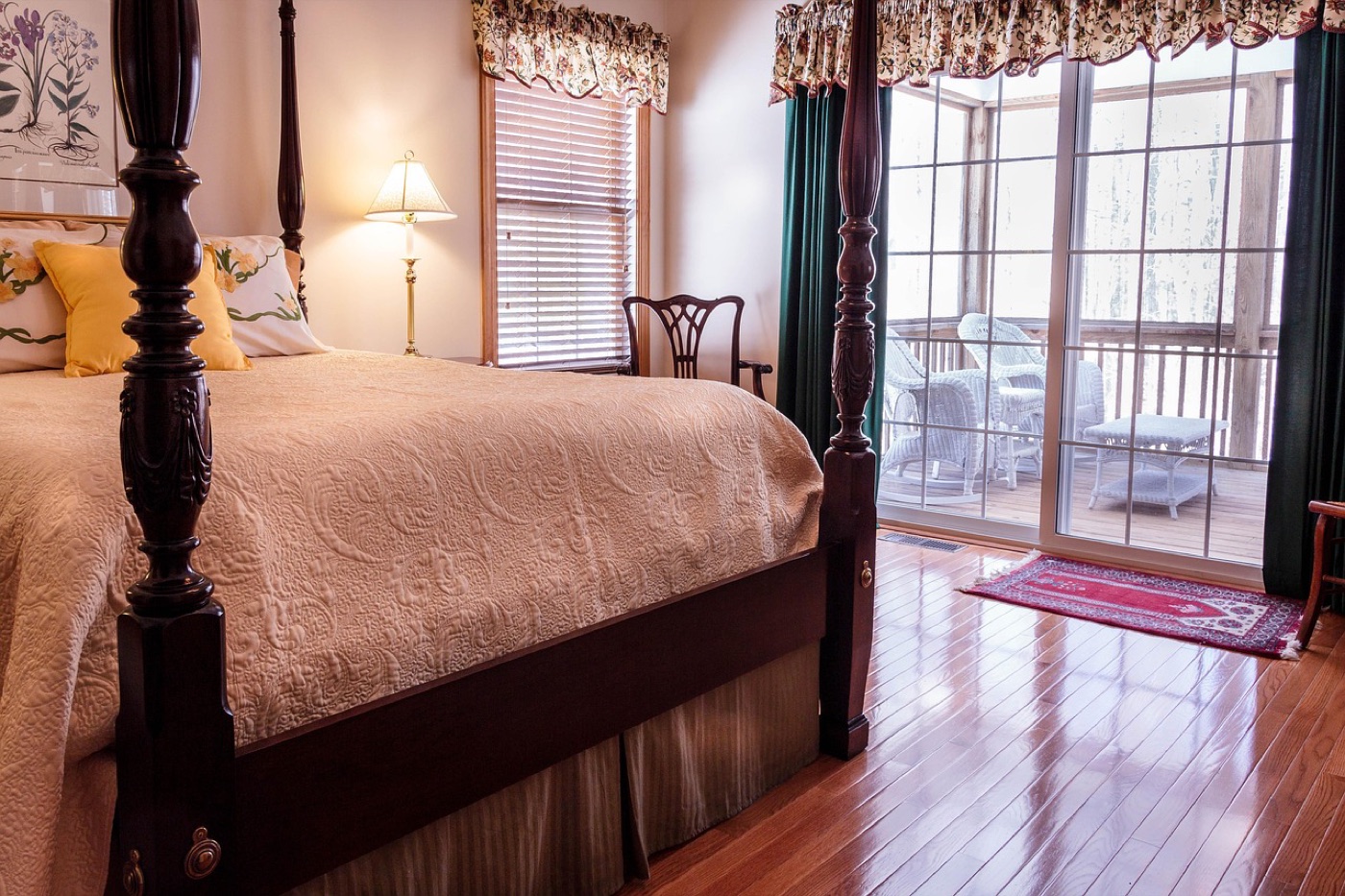
A sliding door is the hardest window in the house to dress, and the reason is arithmetic. The opening is 72 to 96 inches wide, the glass is the view and the daylight, and the door itself moves. Any curtain system must therefore clear the glass when open, cover it when closed, and never block the traffic path. Most disappointments in this category trace to one skipped calculation: where the open stack lands.
The stack problem, stated plainly
Fullness multiplies fabric, and stacked fabric has to go somewhere. A 72-inch door dressed at 2.5 times fullness carries about 180 inches of cloth across its span. Drawn open, that cloth bundles down to roughly a third of its width: call it 30 to 40 inches of stacked curtain per side if both panels pull, or one 60 to 80-inch bundle if the draw is one-way.
Those numbers decide the design before any fabric choice does. If the wall beside the door cannot host the stack, the curtain will live on the glass, semi-open, forever hiding the view it was meant to frame. Measuring for this belongs in the measurement routine for curtains, with one addition: measure the wall run beside the opening, not just the opening.
The fullness lever works in the buyer’s favour here. At 2 times instead of 2.5, the stack shrinks by a fifth, and on a wide door the visual cost is small because the fabric scale is large; the fullness trade-offs are set out in curtain width and fullness.
The four hardware options
Ceiling-mounted track is the default professional answer. Mounted to the ceiling or a bulkhead, it clears the frame completely, carries heavy full-height panels on multiple runners, and draws smoothly under real weight. It solves the height problem that rods have on doors, where the frame leaves no lintel space. Its costs are installation and permanence: screws, anchors, and no moving it later without patching.
Heavy-duty rod with large rings works where there is wall above the frame. The requirements are specific: a rod diameter of at least 28 to 32 mm to resist bowing over a 96-inch span, brackets rated for the load, and rings with generous internal clearance so they do not bind at the brackets. It remains the most forgiving option for renters, and the rod-and-track trade-offs are compared in curtain rods and tracks.
One-way draw is a strategy as much as hardware. All the fabric stacks on one side, ideally the side away from the traffic path and nearest the wall, and the full stack lands where it does the least harm. It halves the stacking requirement per side and suits doors where one edge sits near a corner. The header choice matters here; a heading that stacks compactly, covered in curtain heading types, buys back real inches.
Panel-track systems replace soft folds with wide flat panels on their own carriers. They stack to a fraction of the bulk, often 8 to 10 inches for a full door width, travel smoothly, and suit minimalist rooms. The honest trade is aesthetic: panel tracks read as architectural hardware, not soft furnishing, and they accept limited fabric choices.
The door itself: traffic and clearance
Two door-specific checks get skipped at the cost of daily irritation.
Clearance for the sliding half: the curtain’s closed plane must hang far enough off the glass that the door slides behind it, usually 75 mm or more of standoff, or the curtain must stop short of the sliding half’s travel. Either works; not deciding produces curtains that ride the door handle.
Floor interaction: full-height panels on a traffic door need a floor clearance of 20 to 30 mm, more than the drape rules for stationary windows, because feet and vacuum heads cross this curtain’s path daily. The general drop logic is in curtain drop versus ceiling height, and sliding doors push its minimums higher.
Fabric for a door, not a window
The door environment selects for durability in ways windows do not. Panels on a traffic door get brushed by bodies and hands, so mid-weight woven fabrics with a tight surface outlast delicate textures, and pale colours show the grime transfer. Washability shifts from nice-to-have to central, since these panels clean more often; the fabric-by-fabric rules are in washing curtains by fabric.
Thermal value counts double here, because a glass sliding door is the largest single-pane-scale heat leak in most homes; the sealing logic that makes curtains work thermally is in thermal curtains and insulation, and a door curtain that seals and overlaps centrally does measurable winter work.
The short version for a sliding door: solve the stack first, choose track hardware where possible, bias the draw to one side, and dress it in fabric you will actually wash.
Frequently asked
- How much stack space does a sliding door curtain need?
- Plan on roughly a third of the fabric width as stacked bulk at fullness. A 72-inch door with panels at 2.5 times fullness carries about 180 inches of fabric, which stacks into 30 to 40 inches of bundle when drawn open. That stack has to land on wall or glass beside the door, and finding 34-plus inches of stacking room on each side is the real design problem, not the door.
- What hangs best on a sliding door, a rod or a track?
- A ceiling-mounted track, in most cases. It clears the door frame entirely, handles the weight of full-height panels without bowing, and lets the panels travel their full run without brackets in the way. A rod works where wall exists above the frame and the panels are light; on a 96-inch drop with heavy fabric, rods bow and rings bind.
- Should sliding door curtains cover the glass?
- When closed for privacy or insulation, yes and fully, with overlap in the centre and floor clearance of a centimetre or two. When open, they should clear the glass entirely, because fabric hanging on the glass defeats both the view and the thermal gap that makes the curtain worth having. One-way-draw hardware on the quiet side is the usual compromise.